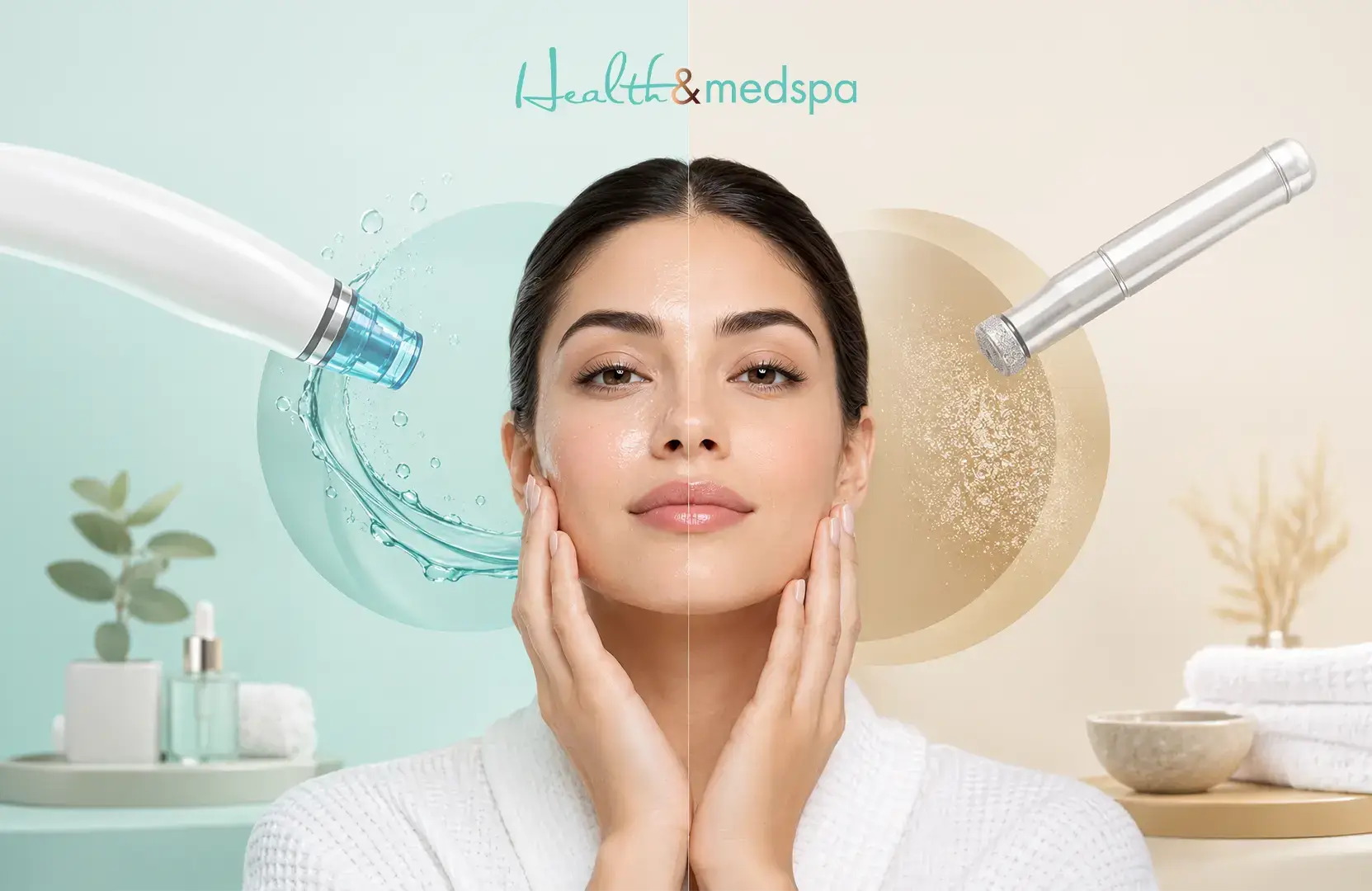
HydraFacial vs Microdermabrasion: Which Is Right for Your Skin?
Choosing between professional facial treatments can feel confusing when both options promise smoother, refreshed-looking skin. The central difference in the HydraFacial vs microdermabrasion comparison is how each treatment exfoliates your skin and what else happens during the session.
Microdermabrasion focuses primarily on mechanical exfoliation. HydraFacial combines exfoliation with cleansing, extraction, hydration, and customizable serum delivery. Neither treatment is automatically right for everyone.
For patients in Tampa Bay, your skin type, sensitivity, sun exposure, current skincare routine, and desired result should guide the decision. A professional assessment can also help identify active skin conditions that may require another approach.
This guide compares the processes, potential benefits, comfort, downtime, costs, risks, and ideal uses so you can discuss the most suitable option with a qualified skincare provider.
Quick Answer: HydraFacial may be suitable when you want cleansing, exfoliation, extraction, and hydration in one customizable treatment. Microdermabrasion may suit someone seeking focused mechanical exfoliation for rough or dull surface texture. Your skin sensitivity, active conditions, recent procedures, medications, and treatment goals should determine the final choice.
Unsure which facial fits your skin?
Explore customized HydraFacial treatments in Tampa Bay and schedule a professional skin assessment.
Key Takeaways
✅ HydraFacial combines several skincare steps in one session.
✅ Microdermabrasion focuses on mechanical surface exfoliation.
✅ HydraFacial offers more opportunities for hydration and customization.
✅ Either procedure can cause temporary redness, tightness, or sensitivity.
✅ Neither treatment should be used to promise the removal of deep scars or wrinkles.
✅ A professional consultation is the safest way to choose between them.
What Is a HydraFacial?
HydraFacial is a branded, non-invasive facial treatment that uses Vortex-Fusion technology. According to the manufacturer, the process combines cleansing, exfoliation, extraction, hydration, and serum delivery.
A typical treatment may include:
- Cleansing and surface exfoliation
- A gentle peel selected for the treatment
- Suction-based extraction
- Hydrating serum delivery
- Optional boosters or LED therapy
The exact protocol depends on the treatment level, available options, skin assessment, and provider recommendations.
At Health & MedSpa, patients can choose among Signature, Deluxe, and Platinum options. Each level includes a different combination of steps and enhancements. Review the available types of HydraFacial before discussing which tier matches your concerns.
What Is Microdermabrasion?
Microdermabrasion is a non-invasive resurfacing procedure that mechanically removes some of the outermost dead skin cells.
A provider may use:
- A diamond-tipped handpiece
- A crystal-based system
- Suction to collect loosened surface cells
The procedure concentrates on physical exfoliation rather than combining exfoliation with hydration and serum infusion.
Microdermabrasion may be considered for concerns such as:
- Dull-looking skin
- Rough surface texture
- Mild unevenness
- Superficial discoloration
- General skin maintenance
Because the procedure works at the surface, expectations should remain realistic. It is not the same as surgical dermabrasion and does not remove deep acne scars or pronounced wrinkles.
Patients interested in a focused resurfacing procedure can explore Health & MedSpa’s microdermabrasion treatment.
HydraFacial vs Microdermabrasion: Key Differences
| Feature | HydraFacial | Microdermabrasion |
| Primary method | Fluid-assisted system with suction | Mechanical exfoliation |
| Main steps | Cleanses, exfoliates, extracts and hydrates | Exfoliates and removes surface debris |
| Hydration | Hydrating serums are part of the treatment | Moisturizer may be applied afterward |
| Extraction | Suction-based extraction may be included | Not the primary purpose |
| Customization | Treatment tiers, boosters and optional enhancements | Mainly adjusted through exfoliation intensity |
| Sensation | Often described as gentle suction or light pressure | May feel mildly scratchy or abrasive |
| Typical downtime | Usually minimal, but reactions vary | Usually minimal, but redness or sensitivity may occur |
| May suit | Multiple concerns, dehydration, congestion or event preparation | Focused surface exfoliation and rough texture |
| Important caution | Ingredients and treatment intensity still require screening | Mechanical exfoliation may irritate reactive skin |
This comparison summarizes common differences. The experience and outcome vary by equipment, protocol, provider, and patient.
Which Treatment Provides Better Exfoliation?
“Better” depends on what your skin needs.
Microdermabrasion uses direct mechanical exfoliation. Someone with resilient skin and rough surface texture may prefer this focused approach.
HydraFacial also exfoliates but combines that step with cleansing, suction, and hydration. This multistep process may make it more suitable when your concerns extend beyond surface texture.
Neither option should be selected solely because it sounds stronger. Excessive exfoliation may disrupt the skin barrier and increase irritation, particularly if you already use retinoids, acids, scrubs, or other resurfacing products.
Which Is Better for Dry or Dehydrated Skin?
HydraFacial may have an advantage when hydration is a primary goal because serum delivery forms part of the treatment. The protocol can be customized based on your skin assessment and available boosters.
Microdermabrasion removes surface buildup but does not provide the same fluid-assisted hydration step. A provider may apply moisturizer afterward, but hydration is not its central mechanism.
However, visibly dry skin can also result from eczema, irritation, medication, weather, or an impaired skin barrier. A skincare professional should determine whether exfoliation is appropriate before proceeding.
Which Is Better for Clogged Pores?
HydraFacial may be considered when you want cleansing, exfoliation, and suction-based extraction during one session. Its combination of steps can address surface buildup and congestion without relying only on manual extractions.
Microdermabrasion can remove some surface debris and dead cells, but extraction is not its principal function.
Neither treatment cures acne. If you have inflamed, painful, cystic, or persistent acne, seek an appropriate skin evaluation instead of assuming that stronger exfoliation will solve the problem.
Which Is Better for Sensitive Skin?
HydraFacial is often chosen when a person wants a customizable, hydration-focused procedure. However, “gentle” does not mean risk-free or suitable for every sensitive skin condition.
Microdermabrasion’s mechanical action may feel more abrasive. The provider may adjust treatment intensity, but patients with reactive skin require careful screening.
Tell your provider if you have:
- Rosacea
- Eczema or dermatitis
- Active acne
- Open sores
- A rash or infection
- Sunburn
- Recent waxing
- Recent laser or peel treatment
- A history of post-inflammatory hyperpigmentation
- Prescription retinoid or isotretinoin use
- Known skincare allergies
Your provider may modify the treatment, postpone it, or recommend another option.
HydraFacial vs Microdermabrasion for Acne Scars
Neither procedure should be marketed as a guaranteed treatment for deep acne scars.
Both may improve the appearance of dullness or superficial unevenness, which can make overall texture look more refined. However, depressed or raised acne scars often require a different assessment and may need treatments specifically selected for scar type.
Those options may include chemical peels, microneedling, laser treatment, or another clinician-recommended procedure. The safest choice depends on scar depth, skin tone, acne activity, and previous treatments.
Comfort, Downtime and Possible Reactions
Both treatments are generally considered minimally invasive, but individual experiences vary.
After HydraFacial
You may notice:
- Temporary redness
- Mild tightness
- Slight sensitivity
- Temporary tingling
- An occasional breakout
After Microdermabrasion
You may notice:
- Redness
- Dryness or tightness
- Tenderness
- Mild swelling
- Temporary sensitivity
- Small abrasions or bruising in some cases
The American Society of Plastic Surgeons identifies potential microdermabrasion risks such as redness, swelling, bruising, tenderness, skin sensitivity, and changes in pigmentation.
Contact your provider if symptoms become painful, severe, widespread, or progressively worse. Seek urgent care for breathing difficulty, facial swelling, or other signs of a severe allergic reaction.
Which Treatment Has Less Downtime?
Both treatments usually involve little downtime, but that does not mean every patient will look or feel normal immediately afterward.
HydraFacial is commonly selected before social events because the treatment combines exfoliation with hydration. Nevertheless, schedule your first session well before an important event so you can learn how your skin responds.
Microdermabrasion may leave a person temporarily pink or sensitive depending on skin type and treatment intensity.
Do not promise yourself a specific recovery time based on someone else’s experience.
Your skin type matters more than a generic comparison chart.
Contact Health & MedSpa to discuss sensitivity, current products, previous reactions, and treatment goals before scheduling.
What Should You Avoid After Either Treatment?
Follow the instructions provided after your procedure. General precautions may include temporarily avoiding:
- Scrubs and cleansing brushes
- Retinoids
- Exfoliating acids
- Waxing
- Other aggressive facial treatments
- Excessive heat
- Picking or rubbing the skin
- Intentional sun exposure
Use a gentle cleanser, suitable moisturizer, and broad-spectrum SPF 30 or higher. Tampa Bay’s frequent sunshine makes post-treatment UV protection particularly important.
The length of these restrictions depends on your skin and the procedure performed.
How Much Do HydraFacial and Microdermabrasion Cost?
Pricing varies based on:
- Treatment level
- Provider experience
- Equipment and supplies
- Boosters or optional enhancements
- Treatment area
- Package or membership options
- Local market
- Recommended number of sessions
HydraFacial may have a higher individual-session price because it combines several steps and may include optional upgrades. Microdermabrasion may have a lower session cost, but the complete expense depends on how many sessions you receive.
Ask for transparent pricing before treatment. Do not choose a procedure solely because it is cheaper or more expensive.
How to Choose Between HydraFacial and Microdermabrasion
Use this decision pathway before scheduling:
- Define your primary goal. Is it hydration, congestion, rough texture, or general maintenance?
- Review your skin sensitivity. Consider previous reactions and active conditions.
- List your current products. Retinoids and exfoliants can affect treatment timing.
- Disclose recent procedures. Include waxing, peels, lasers, and injectables.
- Consider upcoming events. Leave enough time to observe your response.
- Discuss realistic outcomes. Neither treatment can correct every skin concern.
- Complete a professional assessment. Let a qualified provider examine your skin.
For patients seeking several steps in one session, Health & MedSpa may recommend a customized HydraFacial. For those seeking focused mechanical resurfacing, microdermabrasion may remain a reasonable option.
HydraFacial vs Microdermabrasion in Tampa Bay, FL
Tampa Bay residents regularly encounter heat, humidity, and strong UV exposure. These factors can influence oil production, dehydration, sensitivity, and aftercare.
Health & MedSpa is located in Oldsmar and serves patients from Clearwater, Palm Harbor, Safety Harbor, Dunedin, Westchase, Tampa, and nearby communities.
The team evaluates your current skin, concerns, medical and treatment history, and goals before recommending an appropriate facial. This helps avoid selecting a treatment based only on online trends or marketing claims.
Choose the Treatment That Matches Your Skin
The HydraFacial vs microdermabrasion decision comes down to more than which treatment is more popular. Microdermabrasion offers focused mechanical exfoliation, while HydraFacial combines exfoliation with cleansing, extraction, hydration, and customization.
For many patients with multiple concerns or a strong interest in hydration, HydraFacial may offer the more comprehensive experience. However, an assessment remains necessary because active conditions, sensitivity, products, and previous treatments can change what is appropriate.
Stop guessing which facial your skin needs.
Schedule a personalized HydraFacial consultation in Tampa Bay with Health & MedSpa or call 727-444-0995.
Medical Disclaimer
This article provides general educational information and does not replace personalized medical or skincare advice. Treatment suitability, risks, and expected results vary. Consult a qualified provider before undergoing a cosmetic procedure.
Frequently Asked Questions
Is HydraFacial better than microdermabrasion?
Not universally. HydraFacial may be preferable for combined cleansing, extraction, hydration, and customization. Microdermabrasion may suit focused mechanical exfoliation.
Does HydraFacial include microdermabrasion?
No. HydraFacial uses its own fluid-assisted Vortex-Fusion system. Microdermabrasion uses mechanical exfoliation through a crystal-based or diamond-tipped device.
Which treatment is better before an event?
HydraFacial is often considered for event preparation because hydration forms part of the treatment. However, schedule a first treatment early enough to observe your individual response.
Which treatment is better for clogged pores?
HydraFacial may offer an advantage because suction-based extraction can accompany cleansing, exfoliation, and hydration. Active or persistent acne requires a separate assessment.
Is microdermabrasion more aggressive?
It uses direct mechanical exfoliation and may feel more abrasive. Actual intensity and skin response depend on the device, settings, provider, and patient.
Can sensitive skin receive either treatment?
Possibly, but sensitive or reactive skin needs careful evaluation. A provider may adjust the protocol, postpone treatment, or recommend another option.
How often should I receive these treatments?
There is no universal schedule. Frequency depends on skin type, concerns, treatment response, home care, and the provider’s recommendations.
Can I alternate HydraFacial and microdermabrasion?
Potentially, but the timing should be planned professionally to avoid over-exfoliation. Do not stack resurfacing procedures without provider guidance.